afferent-os
The Afferent Operating Environment
Concept · v0.3 · July 2026
An operating environment in which AI is not an application running on the system — the system is the AI’s body. Interfaces are organs, the model is the brain, the human is an observer with a standing ability to intervene, and the screen is not an interface to the system but a projection from it.
GUI = a data stream of every molecule of state.
By day, the organism fits in a laptop; by night, its dreams go to orbit — and come back weighing a few megabytes.
Documents
- English edition — the public version.
- Русский оригинал — the source text; in case of divergence, the original governs.
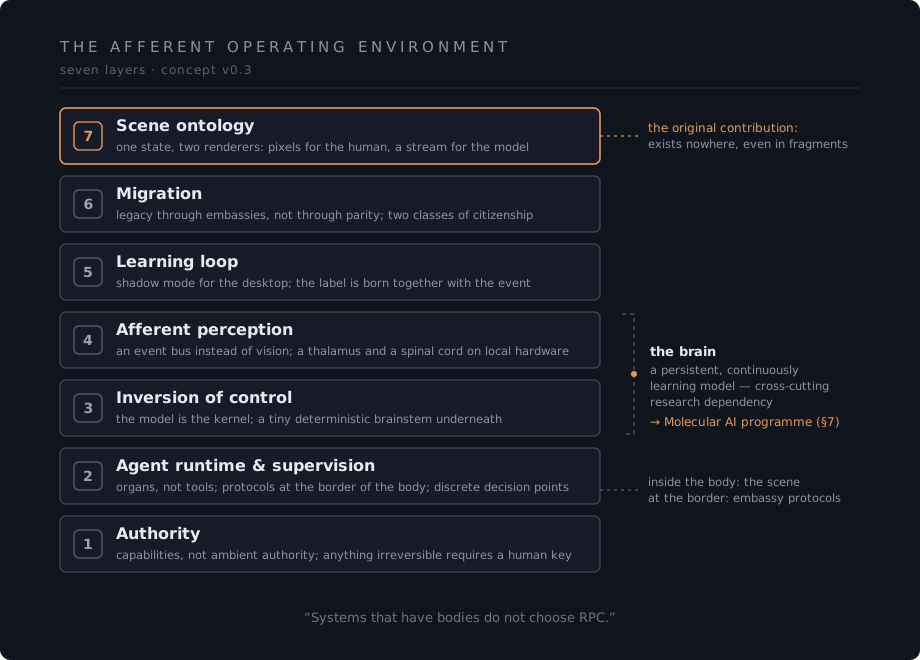
The seven layers
- Authority — capabilities instead of ambient authority; anything irreversible requires a human key.
- Agent runtime & supervision — applications are organs, not tools; protocols belong at the boundary of the body; supervision as discrete decision points, not continuous watching.
- Inversion of control — the model is the kernel; a tiny deterministic “brainstem” underneath; the system as a JIT compiler for intent.
- Afferent perception — an event bus instead of vision: proprioception, a thalamus, and a spinal cord on local hardware.
- The learning loop — shadow mode for the desktop; the label is born together with the event.
- Migration — legacy through embassies, not through parity; two classes of citizenship.
- Scene ontology — one scene of state, two renderers: pixels for the human, a stream for the model. Systems that have bodies do not choose RPC.
The maturity map inside the document is honest about what already ships, what exists in fragments, and what exists nowhere: Layer 7 is the original contribution, and the cross-cutting dependency — a persistent, continuously learning model — points to the Molecular AI research programme (§7 of the concept).
Status
A concept document, not an implementation. Version 0.3. The English edition is a translation of the Russian original.
License & authorship
Licensed under CC BY 4.0. The document is a product of dialogic co-authorship with asymmetric responsibility: the seven formulations that constitute the concept are the author’s; the development, critique, and landscape mapping emerged in dialogue with an AI assistant (Claude, Anthropic). Responsibility for the content rests with the human author.